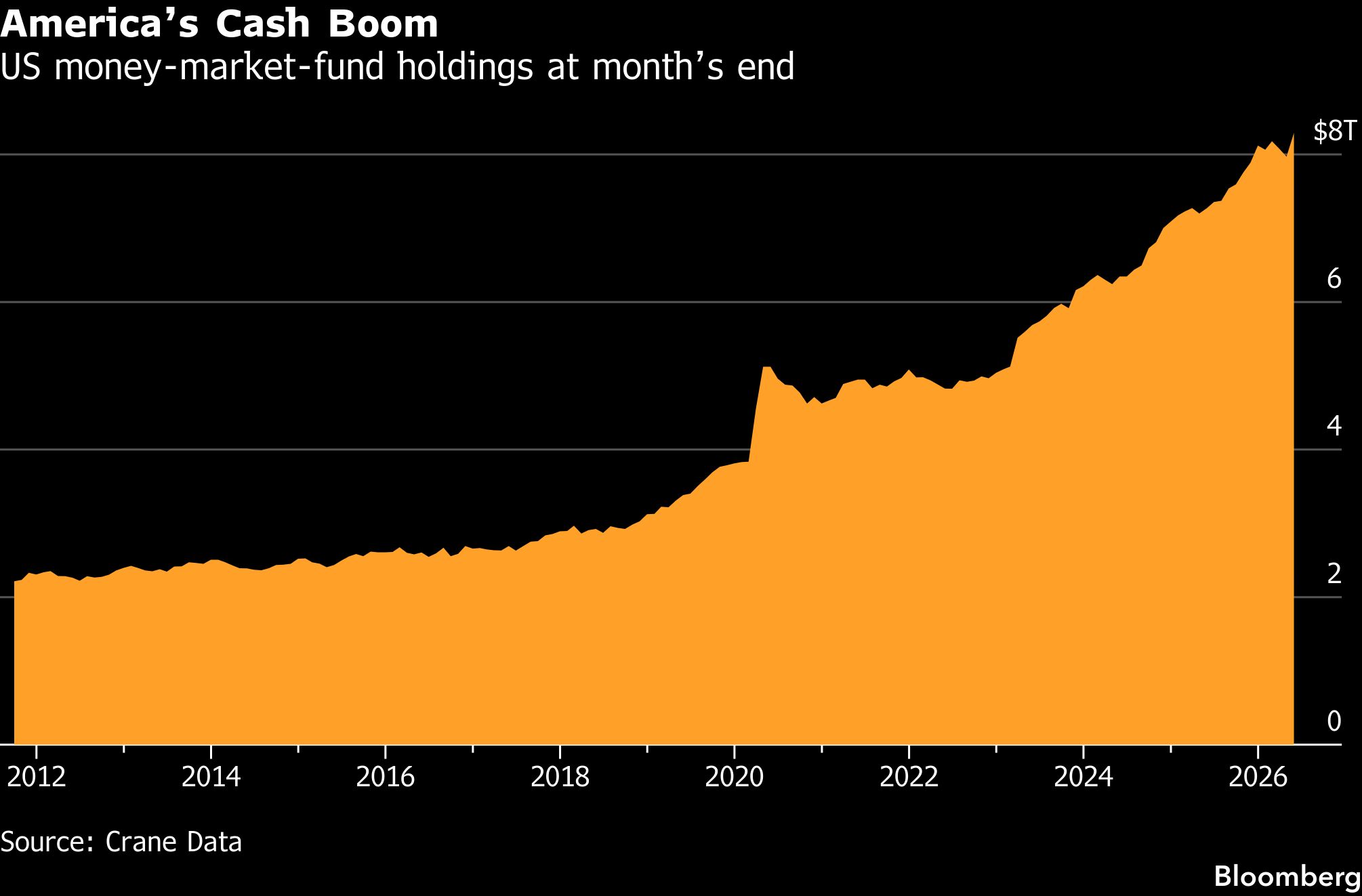
The stock market keeps setting records. Bitcoin has minted millionaires. Gold has peaked at new levels. Yet one of the most popular trades is to sit in cash or, more precisely, money-market funds. These plain‑vanilla vehicles, which invest in short‑term debt, have become the default parking spot for everyone from retail savers to corporate treasurers.
The US money-market industry now holds a record $8.29 trillion — almost twice the size of Japan’s economy — after inflows topped $1 trillion last year, according to Crane Data LLC, which tracks the industry. The strategy’s popularity has been accompanied by a Wall Street catchphrase, “T-bill and chill,” which has come to signify investors’ preference for the short-term Treasuries these funds often hold.

“Convenience is king with cash,” says Peter Crane, president of Crane Data. “It’s the ultimate hedge when other assets like Bitcoin and gold have done more going up and going down.”
Stability in finance has been rare over the past decade as the Covid-19 pandemic, geopolitical conflicts and the rise of artificial intelligence unleashed uncertainty across global markets. The volatility has pushed safety-minded investors toward money-market funds, where the appeal is the combination of stability and returns. Yields on the 100 largest funds were near 3.5% at the end of April, according to a Crane Data index.
With long‑dated bonds still sensitive to shifts in interest-rate expectations, many savers have gravitated toward short‑term vehicles instead. Money‑market funds invest in very short‑dated government securities (though some can also hold high-quality short-term corporate debt), aim to maintain a stable $1 share price and adjust to changes in rates more quickly than bank deposits. That combination has made them a popular place to park cash, especially for households and businesses with balances above the $250,000 federal insurance cap.
Jessica Perrone, who’s spent 16 years as a financial professional and teaches personal finance, says two kinds of savers are moving toward cash. High‑net‑worth households — the type juggling summer spending, second homes and market highs — are reacting to climbing oil prices and corporate margins that look vulnerable. But she’s also noticing a shift among everyday workers in her financial‑wellness workshops, as conflicting headlines and market volatility push people to “start taking their chips off the table” by parking their money in more predictable assets.
Investors are calculating that they can get a decent yield with no risk “or maybe 5.5% to 6% elsewhere with the possibility of losses,” says Jeff Judge, a managing partner at Chesapeake Financial Planners, who’s observed similar trends among his clients. “For some, that’s an easy decision.”
To Amrita Bhasin, a 25-year-old tech worker in California, money-market funds feel easier to manage than, say, certificates of deposit, where cash is locked up for a specific period and subject to penalties. “With money-market funds, I feel like I have more visibility and control over what’s happening with my money,” she says. “I want to understand where my money is, what yield I’m getting and how it’s changing.”
The interest appears to extend to other age groups. Judge has seen higher demand for cashlike instruments among younger investors such as Bhasin, while Laurie Brignac, chief investment officer at asset manager Invesco Ltd., says the preference is also strong among American baby boomers. While they’re not necessarily disinvesting from risk assets, she says, “their investments are kicking off more cash,” and the gains get redirected to safer holdings. Overall, money-market funds made up almost 4.5% of total wealth at the end of 2025, according to Federal Reserve data, compared with about 3% prior to the hiking cycle that began a decade earlier.
Even incoming Fed Chairman Kevin Warsh says he plans to keep much of his own wealth in such vehicles as he steps into one of the most scrutinized jobs in global finance. In his case, the uncontroversial nature of cashlike instruments is appealing. He recently disclosed assets with his wife, Jane Lauder, that total at least $192 million, and he’ll have to comply with personal investing rules that were significantly tightened in 2022 after a series of embarrassing revelations of trading by Fed officials.
Businesses, meanwhile, are piling into the trend to safeguard flexibility for investment and strategic moves. Nonfinancial companies had amassed almost $6.2 trillion in cash and short-term instruments at the end of 2025, according to institutional brokerage SMBC Nikko Securities America Inc., up 4% on the year. Joseph Abate, head of the firm’s US rates strategy, estimates businesses are holding cash at about 20% of their total liabilities, with a portion in money-market funds. He expects levels to remain elevated as long as the funds yield more than 3%.
One example is the publicly traded company that owns the Atlanta Braves baseball team, which said on a May earnings call that nearly all $135 million of its cash and equivalents were held in US Treasuries, money-market funds and other financial and corporate debt. Alphabet Inc. also parks a large chunk of its cash and equivalents, more than 40% at the end of March, in such funds.
While Wall Street forecasters have long warned that a “wall of cash” would rush out of money-market funds and into riskier assets once the Fed started cutting interest rates, investors kept piling in last year even as the central bank lowered borrowing costs three times. Renewed market volatility in recent months, fueled in part by the Iran war and a spike in oil prices, has only reinforced the appeal of cashlike assets, with inflows continuing in 2026, according to Crane Data.
Financial planning firm Ameriprise Financial Inc. has observed a similar trend: Even though client balances in products such as money-market funds and brokered CDs dipped earlier this year, they were “elevated” by the end of March, Chief Financial Officer Walter Berman recently told shareholders.
“I’ve been hearing the ‘wall of cash’ theory since money funds hit a trillion in 1997,” Crane says. “That’s the fallacy underneath the zero-sum thinking that people believe if something goes up, something else must go down.”
A message from Advisor Perspectives and VettaFi: Discover something new! Click here to register for our upcoming webcasts.
Bloomberg News provided this article. For more articles like this please visit
bloomberg.com.
More Commodities Topics >