It’s earnings season, and as I write this, profits for S&P 500 companies are down roughly 34 percent compared to the same time a year earlier, with 62 percent of companies reporting.
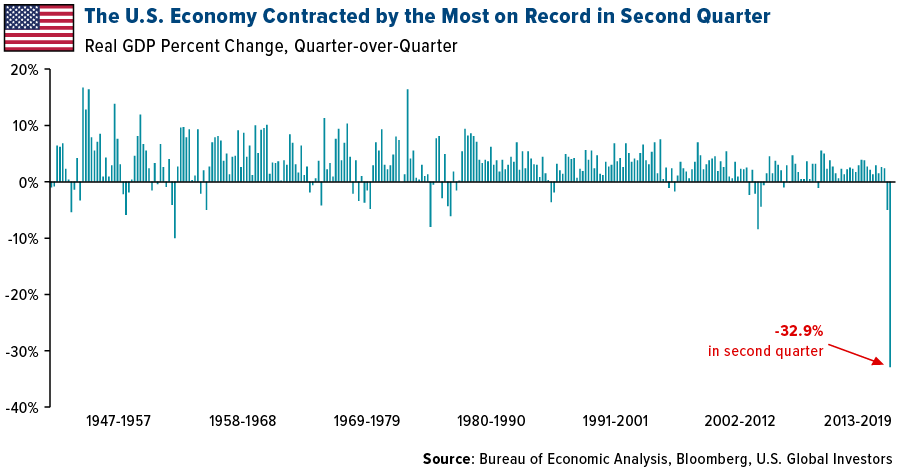
Coincidentally, that decline is close to the rate at which the U.S. economy shrank in the second quarter due to coronavirus lockdown measures. U.S. GDP plunged an historic 32.9 percent compared to the previous quarter, the fastest pace on record.
I know that sounds bad—and for the millions of Americans who are still out of work, it is—but I expect third-quarter GDP to be just as historic on the upside.
click to enlarge
Not all companies have suffered in the age of COVID-19, though. Big tech earnings surged as a large percentage of the population was restricted to staying home, surfing the internet and making purchases online.
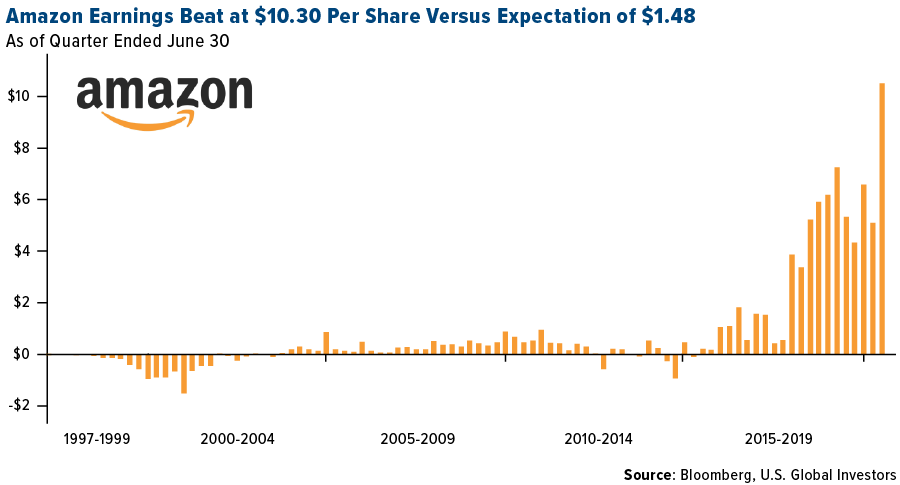
Retail giant Amazon had among the largest earnings beats, despite costs associated with the virus—protective gear, mostly, but also bonuses—reaching $4 billion. Earnings per share (EPS) came in at an off-the-charts $10.30, seven times above Wall Street’s expectation of $1.48. That’s the highest-ever EPS in the company’s 23 years as a publicly listed company. According to Amazon, video hours on Amazon Prime doubled during the three months. Online grocery sales tripled.
click to enlarge
Copper Miner Ivanhoe Mines at an Advantage After Chile’s Charge Against BHP
Metal miners have also been reporting strong profits as prices for both industrial and precious metals were up during the quarter. Total earnings for those that have reported stand at more than $713 million, compared to estimates of $216 million.
Just under 40 North American gold producers have reported so far out of 284. Sales have been right in line with expectations, but earnings have surprised to the upside, with Yamana Gold, New Gold, Sandstorm Gold and Dundee Precious Metals pulling off the biggest beats.
Two companies in the metals and mining space I’m looking forward to hearing from are Ivanhoe Mines and Franco-Nevada. Both are scheduled to report next week.
For the two-year period, copper producer Ivanhoe has far outperformed copper prices and an index of global copper miners. Like most industrial metal producers, its stock price fell on fears the coronavirus would lead to mass mine closures and a global slowdown in demand for the red metal. Since hitting the bottom in mid-March, Ivanhoe shares have exploded more than 142 percent.
click to enlarge
In a press release dated July 27, Ivanhoe founder and co-executive chairman Robert Friedland (pictured below, from when he visited our office in January 2018) calls 2020 an “extraordinary year” for metal prices. Copper is at a two-year high, silver at a silver-year high and gold at an all-time high.
“Our tier-one projects in Africa will produce all of these metals,” Robert says, referring to the company’s 100 percent-owned Western Forelands Project, Kamoa-Kakula mining license and Platreef Project.
Copper prices have been supported by global supply strains due to the pandemic, and further disruptions are a real possibility. Today, the Chilean government announced it would charge BHP, the world’s largest copper producer, for drawing too much water from the Chilean desert at the company’s Escondida copper mine.
Credit Suisse analysts rate this news as negative, as BHP could be fined, have its environmental permit revoked or even forced to close Escondida.
I agree that this is negative for BHP, but it could be positive for other copper mining jurisdictions, especially those that are friendlier to metal producers and that have an abundance of fresh water. That includes the Democratic Republic of the Congo (DRC), where Ivanhoe operates.
“We are blessed with incredibly high-grade depoists in areas that have an abundance of clean, sustainable hydro power potential—providing us with a distinct advantage in our goal to become the world’s ‘greenest’ miner,” Robert said in June, speaking of the Kakula Mine, which sits on the mighty Congo River.
Franco-Nevada Rises to Number 8 on IBD 50 Stock List
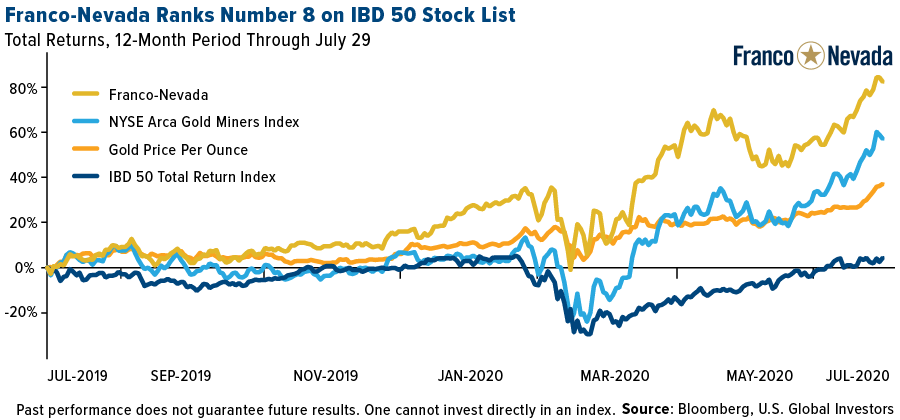
I’m also expecting a strong report from Franco-Nevada. The world’s largest gold royalty company is up more than 83 percent for the 12-month period, beating gold producers and the price of the yellow metal.
click to enlarge
It’s also beating the IBD 50 Index, which I’m including below because Franco-Nevada is now a member of the IBD 50 Stock List, the publication’s flagship screen of leading growth stocks. On Thursday the stock climbed to number eight on the list and is currently ranked first in the Mining-Gold/Silver/Gems Group based on its earnings potential. Analysts are looking for earnings growth of 41 percent in the second quarter, according to IBD.
Good for Gold: U.S. Yields Hit All-Time Lows
Spot gold continued to trade near all-time highs Thursday and Friday in its quest to break through $2,000 an ounce. Supporting the yellow metal was a falling U.S. dollar and anticipation of another round of fiscal stimulus. The real yield on the 10-year Treasury closed at a record low on Tuesday. The bond continued to trade lower throughout the week, falling to negative 95 basis points.
click to enlarge
This week I shared with you my thoughts on gold being overbought, and whether this should prompt selling. In the period between 1980 and 1999, taking your profits was a good strategy after gold became overbought, but that same strategy has not worked in investors’ favor since 2000.
Click here to see my complete analysis.
Congratulations, Thunderbird!
Some of you may not know that besides my roles at U.S. Global Investors and HIVE Blockchain Technologies, I am also an independent director at Thunderbird Entertainment, which was involved with the production of 2017’s Blade Runner 2049, among many other films and TV shows.
I’m pleased to tell you that Thunderbird recently received some well-deserved accolades. Among them was an Emmy and four Leo Awards for the Netflix family series The Last Kids on Earth, three Leo Awards for the Canadian sitcom series Kim’s Convenience, and a Leo Award for the documentary TV series Highway Thru Hell. Congratulations to all who were involve!
Gold Market
This week spot gold closed at $1,975.86, up $73.84 per ounce, or 3.88 percent. Gold stocks, as measured by the NYSE Arca Gold Miners Index, ended the week higher by 2.80 percent. The S&P/TSX Venture Index came in up 4.32 percent. The U.S. Trade-Weighted Dollar fell 1.0 percent and had its worst monthly drop of 4.04 percent in a decade.
| Date |
Event |
Survey |
Actual |
Prior |
| Jun-27 |
Hong Kong Exports YoY |
3.8% |
-1.3% |
-7.4% |
| Jun-27 |
Durable Goods Orders |
6.9% |
7.3% |
15.1% |
| Jun-28 |
Conf. Board Consumer Confidence |
95.0 |
92.6 |
98.3 |
| Jun-29 |
FOMC Rate Decision (Upper Bound) |
0.25% |
0.25% |
0.25% |
| Jun-30 |
Germany CPI YoY |
0.1% |
-0.1% |
0.9% |
| Jul-30 |
GDP Annualized QoQ |
-34.5% |
-32.9% |
-5.0% |
| Jul-30 |
Initial Jobless Claims |
1445k |
1434k |
1422k |
| Jul-31 |
Eurozone CPI Core YoY |
0.8% |
1.2% |
0.8% |
| Aug-2 |
Caixin China PMI Mfg |
51.1 |
-- |
51.2 |
| Aug-3 |
ISM Manufacturing |
53.6 |
-- |
52.6 |
| Aug-4 |
Durable Goods Orders |
-- |
-- |
7.3% |
| Aug-5 |
ADP Employment Change |
1200k |
-- |
2369k |
| Aug-6 |
Initial Jobless Claims |
1450k |
-- |
1434k |
| Aug-7 |
Change in Nonfarm Payrolls |
1510k |
-- |
4800k |
Strengths
- The best performing metal for the week was silver, up 7.13 percent, again outpacing gold on recent gains. Spot gold broke its record high this week and could soon hit $2,000 an ounce. Bullion rose as high as $1,983.36 on Friday and is up 10 percent for July – its best month in four years. Precious metals producers are soaring thanks to gold and silver’s gains. The NYSE Arca Gold Bugs Index rose 108 percent from a March 13 low through July 24. The Solactive Global Silver Miners Index rose 117 percent over the same period.
- The real yield on 10-year Treasuries closed at its lowest level ever of negative 0.9277 percent on Tuesday. This greatly boosts gold’s appeal since it does not offer interest like government bonds usually do. Germany became the biggest retail buyer of gold bars and coins by the end of the second quarter, taking the top spot from China, according to the World Gold Council (WGC).
- The number of gold bulls is growing. Bank of America is sticking by its forecast for $3,000 an ounce gold over the next 18 months. Citigroup said that the current gold cycle is unique and prices could “stay in a higher range for longer.” Goldman raised its 12-month price forecast to $2,300. Miners are also bullish. Agnico Eagle Mines CEO Sean Boyd said, “we would not be surprised to see $2,500 within the next two years because there’s still so much uncertainty out there.”
Weaknesses
- The worst performing metal for the week was palladium, down 6.12 percent even though hedge funds boosted their net long position to a 21-week high, however, Nornickel announce a 32 percent quarter-over-quarter growth in its production of palladium taking some of the enthusiasm out of the price. Gold retreated on Wednesday after rallying for nine straight days that led to its record price. Investors weighted impending U.S. GDP data and second-quarter corporate earnings.
- The U.S. Mint said it has reduced the volume of gold and silver coins for distribution as the pandemic slows production. A document obtained by Bloomberg says that the Mint’s West Point complex in New York will probably slow coin production for 12 to 18 months as it implements measures to prevent the virus spreading among employees.
- JPMorgan says the gold rally could start to lose steam in the second half of this year. Analysts said in a report that “gold will likely see one last hurrah before prices turn lower into year-end.” Some believe that the gold rally is overdone and will correct soon after rising 29 percent so far this year.
Opportunities
- Gold’s new record price is winning over a wider fan base of pension funds, insurance companies and private wealth specialists, reports Bloomberg. Government bonds have been a traditional safe haven asset, but with bonds yielding next to nothing in the era of near-zero interest rates, the appeal for gold, which does not pay interest, rises. “We need to diversify our diversifier and look for safe haven beyond government bonds,” said Geraldine Sundstom of Pacific Investment Management Co.
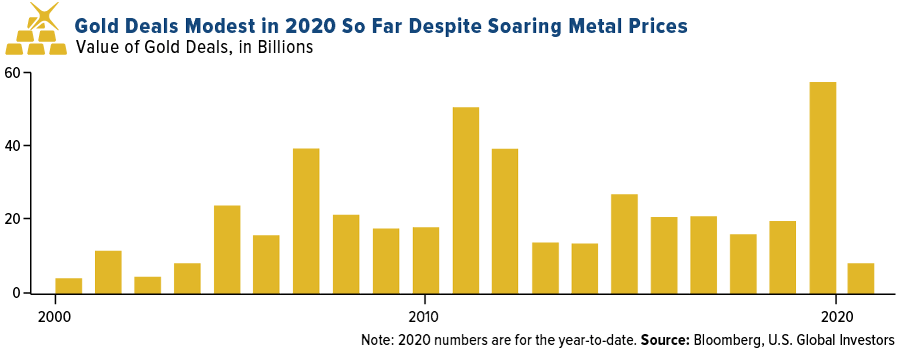
- Gold mining stocks are set to be massive beneficiaries of bullion’s rally, creating a “fat pitch”. However, miners are known for overspending and destroying shareholder value in previous cycles. So long as miners don’t repeat the mistakes of previous rallies, they should attract a surge in money flows. Gold deals are modest in 2020 despite higher metal prices, but the opportunity is there.
click to enlarge
- Desjardins’ gold analyst David Stewart raised his price target on K92 Mining and wrote these positive remarks: “We are increasing our target to C$9.75 based on the recently released Stage 3 expansion PEA results, which beat our expectations across the board. We see the mine plan as transformative not only because it is self-funded (positive FCF even in expansion years), but because it will vault K92 into the intermediate producer category and create one of the lowest-cost producers in the industry. We see the PEA as a solid base from which to grow as exploration continues to expand resources.”
Threats
- Plummeting gold demand out of India could continue for longer than expected. Consumption fell in the first half of this year by 56 percent from a year earlier to 165.6 tons, according to the World Gold Council (WGC). “For gold demand to survive, the economy has to do well” and India’s economy has been hit severely by Covid-19 lockdowns, says P.R. Somasundaram of the WGC. However, if the economy were to surge back to life then demand could skyrocket.
- Billionaire investor Ray Dalio is warning of a “capital war” between the U.S. and China that could push the dollar down and lose its status as the world currency. “There’s a trade war, there’s a technology war, there is a geopolitical war and there could be a capital war,” Dalio said on Fox TV over the weekend. Although gold historically moves in the opposition direction of the U.S. dollar and would likely benefit from it going lower, this is still negative overall for the U.S.
- AngloGold Ashanti, the world’s third largest gold producer, announced that CEO Kelvin Dushnisky is stepping down after two years on the job. According to people familiar with the matter, shareholders pushed Dushnisky to leave after asking for further investigation into a bonus payment made by his previous employer Barrick that wasn’t initially disclosed. Bloomberg reports that before working at AngloGold, Dushnisky agreed to a signing bonus to made up for a Barrick payment that he would lose out on. However, Barrick’s annual report showed that he did in fact receive the bonus and was asked by the board to repay it.
Blockchain and Digital Currencies
Strengths
- Of the cryptocurrencies tracked by CoinMarketCap, the best performing for the week ended July 31 was Spendcoin, up 711.50 percent.
- At the start of the week the price of bitcoin pushed through the $11,000 level in a high-volume surge, reports CoinTelegraph, which saw the price reach a new 2020 high at $11,394.
- On Thursday, the dollar dropped to its lowest level since May 2018 as the Federal Reserve said it plans to keep interest rates close to zero, and inflation hedges continue to show strength, writes CoinTelegraph. As the dollar weakens, however, both gold and bitcoin appear to be soaring. Bitcoin had been stuck in a tight trading range for over two months, but as mentioned above, broke above $11,400 on Tuesday, following the rally in precious metals.
Weaknesses
- Of the cryptocurrencies tracked by CoinMarketCap, the worst performing for the week ended July 31 was Seele-N, down 86.99 percent.
- Wirecard, a controversial German payments processor and issuer of several crypto debit cards, has been implicated in a new report on alleged criminal activities by a Mastercard executive operating at the troubled FBME bank in Cyprus, writes CoinTelegraph. In the latest chapter of the saga at FBME, the unnamed Mastercard exec. Has been accused of a money laundering cover-up using a system of “phantom transactions” designed to thwart detection by Visa and Mastercard’s anti-fraud and money-laundering checks.
- Bitcoin could very well register its best July price performance for eight years, writes CoinDesk, confirming a major bullish breakout in the process. The popular digital currency is up nearly 22 percent this month, and just needs to hold above $11,145 until today’s close to confirm the biggest gain since July 2012, when prices rallied by 40 percent.
Opportunities
- Max Keiser of the Keiser Report says that bitcoin will not stop rising until it hits $28,000, reports CoinTelegraph, as the largest cryptocurrency gains over 20 percent in a week. In a series of tweets on July 27, Keiser forecast that BTC/USD is heading for six figures after a correction period near $30,000.
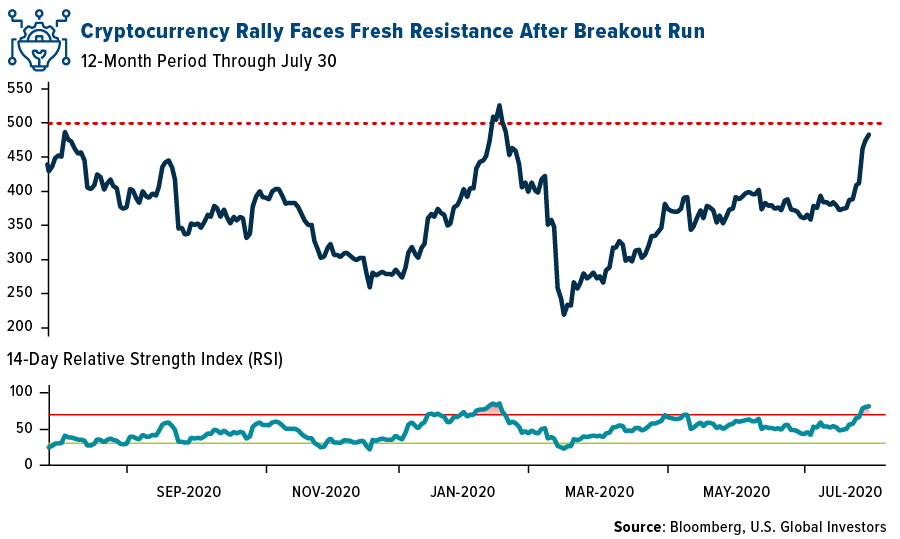
- An index of the top cryptocurrencies is set to reface a psychologically important resistance level that’s checked its rise in the past. The Bloomberg Galaxy Crypto Index, which measures the largest digital coins that trade in U.S. dollars, has surged close to 35 percent in July alone, as of the 30th, and is roughly 15 index points away from meeting resistance at the 500 level. The 14-day relative strength index (RSI) appears overextended. If the group can exceed the 500 threshold, the next test may be 600.
click to enlarge
- Iran has announced that it will now allow industrial-scale power plants in the country to operate as bitcoin miners, reports CoinTelegraph, provided they don’t use subsidized fuel and as long as they “comply with approved tariffs.”
Threats
- A state-backed blockchain infrastructure project from China hopes to be the dominant internet services provider for decentralized applications (dapps), writes CoinDesk. Even though the first-mover advantage is significant, geopolitical risks are real, particularly as U.S.-China relations become increasingly tense. The project called the Blockchain-based Service Network (BSN) is a Chinese state-sanctioned blockchain project, but few may realize the network is supported by U.S. technology companies.
- The Security Service of Ukraine (SSU) detained terrorists who demanded bitcoin in return for not blowing up buildings in the country’s capital, writes CoinDesk. A post on SSU’s Facebook profile detailed two 60-year-old men who posted a paper note on an apartment building in Kyiv threatening to blow up that building or another one if they did not receive 50 BTC to their bitcoin address. The alleged terrorists even detonated a small bomb near a subway station to prove they were serious.
- One of the largest scams in the cryptocurrency industry known as PlusToken is taking another twist as dozens of major suspects have been arrested, reports CoinTelegraph. According to a July 30 report by local industry publication ChainNews, as many as 27 core PlusToken team members have been arrested by Chinese police. The total amount of losses in the scam is estimated at 40 billion Chinese yuan, or $5.7 billion.
© US Global Investors
www.usfunds.com
© U.S. Global Investors
Read more commentaries by U.S. Global Investors