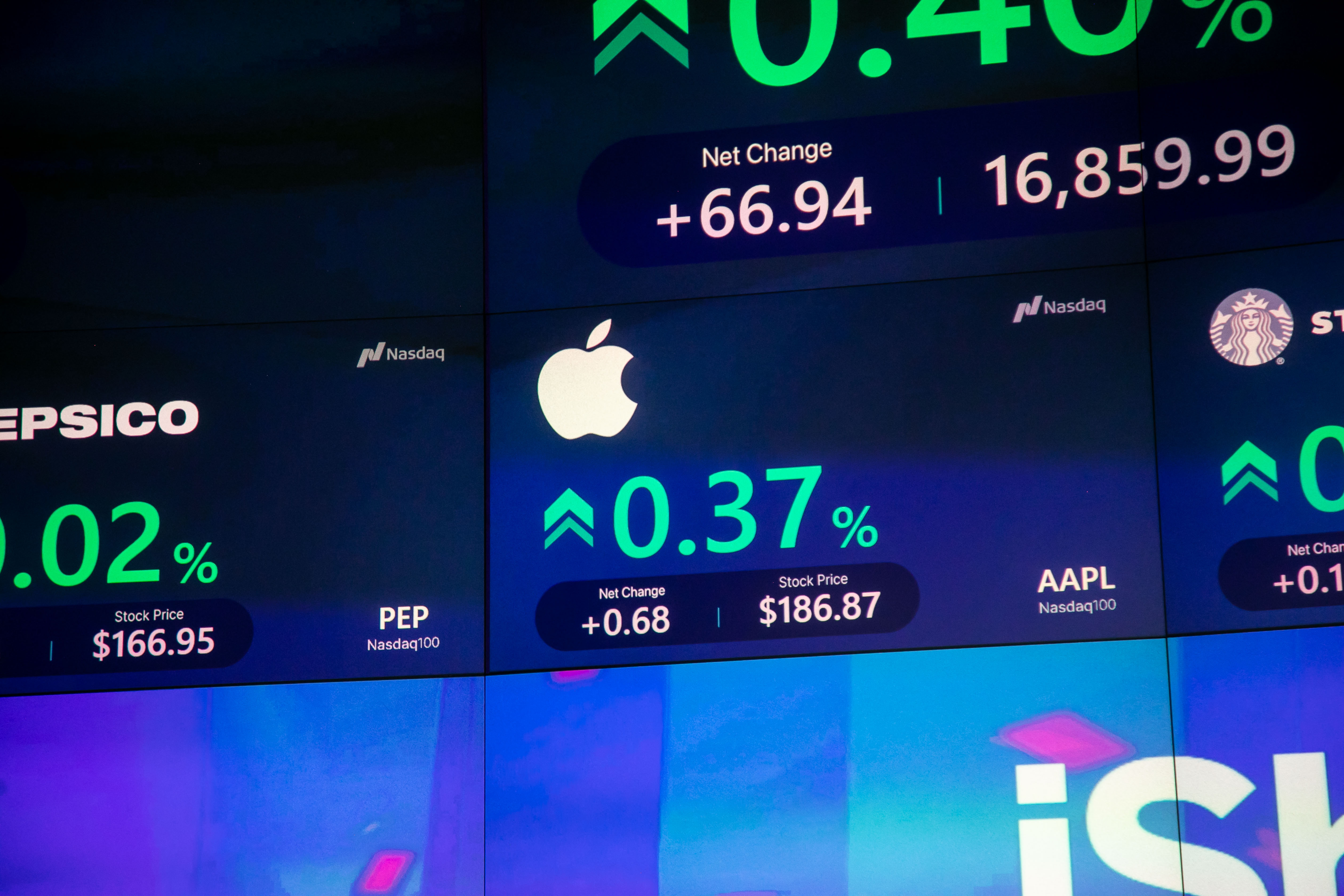
There’s no shortage of market-moving events on the docket to keep Wall Street busy right now.
Our outlook on the 11 S&P 500 equity sectors.
Build a dividend growth portfolio. The stock market as measured by the S&P is currently at an all-time high which makes it very challenging to try to build a quality dividend growth portfolio.
Since early last year, the cars rolling off Tesla Inc.’s California assembly lines have been selling for steadily lower prices. This has had a happy knock-on effect on a car lot just across the freeway from the company’s San Francisco Bay area factory.
Over nearly three decades, I’ve been dedicated to the sport of running. For the last five years, I chased the elusive goal of qualifying for the Boston Marathon, my ultimate aspiration. It wasn’t until I sought the expertise of a professional coach that I finally achieved this dream.
Governments in the US and other developed countries, thanks to their central banks, may be deluded over how much debt they can pile up without significantly raising their costs to borrow.
An Oaktree Capital Management LP venture plans to seek an equity partner to help develop a Dublin project that’s expected to be valued at billions of euro when it’s completed, according to people with knowledge of the matter.
Deep value stocks are currently our highest conviction long-only investment idea. For the avoidance of any doubt, when we talk about “deep value,” we simply mean stocks that are cheap, often screamingly so, relative to our appraisal of their fair value. We do not care about a “growth” or “value” label that has been assigned, sometimes seemingly arbitrarily, by one index provider or another.
Although we think it's too early to declare the economy is in a recession, risk is elevated. For investors who are concerned about a recession, municipal bonds may help buffer a portfolio.
Treasuries rallied after Federal Reserve Chair Jerome Powell’s speech at Jackson Hole cemented expectations that the central bank will cut interest rates next month.
Chair Jerome Powell said the time has come for the Federal Reserve to cut its key policy rate, affirming expectations that officials will begin lowering borrowing costs next month and making clear his intention to prevent further cooling in the labor market.
It’s the hottest trade on Wall Street. Everywhere you turn, money managers have upped their investments in private credit, helping the asset class balloon into a $1.7 trillion industry. But there’s one group where interest appears to already be waning — the family office.
A labor market softening more so than previously thought should spur faster and steeper interest-rate cuts by the Federal Reserve, according to the latest Bloomberg monthly survey of economists.
Recent economic data points have been mixed. On the more positive side of the ledger, there’s evidence that inflation is cooling and consumer spending remains sturdy. Conversely, the jobs market is cooling.
Are we going to have a recession? Are we already in a recession?
The Big Tech boom is causing headaches for all-powerful index providers on Wall Street, who can send billions of benchmark-tracking dollars on the move with just a stroke of the pen.
With recent cooling in economic growth, an uptick in unemployment, inflation moderating back to the Federal Reserve’s (Fed) 2% target, and expectations for rate cuts, we believe the winds are shifting in the U.S. fixed income market.
After market expectations spiked to nearly five interest rate cuts in 2024 based on disappointing labor market report early in the month, reassuring data in the form of Retail Sales and Unemployment Claims have quelled market Markets have eased expectations for interest rate cuts, pricing closer to four cuts as of the end of last week.
Before the pandemic hit in 2020, a decade-long bull run in the stock market saw the 60/40 portfolio slowly fall out of favor. With market volatility returning, that 60/40 split appears to be making a comeback.
If interest rates decrease over the next 12 months, as the market expects, long duration bonds could potentially provide equity-like returns for investors.
Robust U.S. stock momentum hit a slowdown in the third quarter, even as strong company earnings results rolled in. Fundamental Equities’ U.S. and Developed Markets CIO Carrie King weighs in on the incongruence with three reflections from Q2 earnings season.
It’s widely expected that the Federal Reserve will cut interest rates next month, perhaps by as much as 50 basis points. That would potentially provide a much needed positive jolt to bonds and fixed income ETFs.
Call me Ishmael. The biggest question about an investment banking client like Elon Musk is whether he turns out to be a Moby Dick.
One of the most widely followed gauges of the stock market, for decades a reliable indicator of future returns, has led investors astray in recent years. Its misdirection comes down to the freakish earnings growth of big technology companies such as Apple Inc. and Alphabet Inc.
Technology giants that want to spend big on artificial intelligence and stay in the good graces of investors should take a page out of Meta Platforms Inc.’s playbook.
Emerging-market stocks are trading at the steepest discount to US equities since the Covid-19 panic in March 2020 as skittish investors look elsewhere for growth opportunities.
The euro’s August gains have been relentless, taking it to a one year high against the dollar on Wednesday, but a cautious tone from Federal Reserve Chair Jerome Powell on Friday could turn that momentum around.
Since our last update of the Three Tactical Rules on June 25, 2024, equity markets have retraced most of the rally from the spring. The change in market sentiment came abruptly, due to the labor market showing signs of weakness as the number of jobs available per unemployed worker fell to 1.2 and the unemployment rate rose to 4.3%. The recent market volatility has had a dramatic impact on our tactical rules.
Amid expectations of rate cuts from major central banks, managers are increasing their exposure to more cyclical and value-oriented names, including autos, transportation, and short-cycle industrials.
The last two years of high school can be particularly important as students approach the final college decision. Our Bill Cass highlights some action items for students and parents.
With its current course leading only to economic stagnation, the EU must establish a vision for a more dynamic, productive future. Above all, Europeans must answer a simple but critical question: What should the EU look like – in terms of innovation, the economy, security, and resilience – in a decade?
Since the end of the financial crisis, economists, analysts, and the Federal Reserve have continued to predict a return to higher levels of economic growth. The hope remains that the Trillions of dollars spent during the pandemic-driven economic shutdown will turn into lasting organic economic growth.
Active management can lead to high portfolio turnover and a higher tax bill. Wealth managers might feel that an active strategy could be too inefficient for clients who are sensitive to taxes. Find out how implementing a core-satellite portfolio with a direct indexing core may improve tax efficiency.
Earning returns for clients matters, and so is reducing taxes they pay. Clients looking to retain wealth from their portfolios, expect their advisors to be proactive when it comes to managing taxes.
Join the professionals at AssetMark to hear about tax management services that can help your clients keep more on their returns.
When feedback is done well, it can be the greatest gift you give to someone.
Having the best referral in the world doesn’t convert a prospect. It’s your website that seals the deal, not only for referrals but for organic prospects as well.
Many financial advisors exhibit a risk-averse attitude, leading to missed opportunities for growth and innovation.
Economic indicators provide insight into the overall health and performance of an economy. They are essential tools for policymakers, advisors, investors, and businesses because they allow them to make informed decisions regarding business strategies and financial markets. In the week ending on August 15th, the SPDR S&P 500 ETF Trust (SPY) rose 0.14% while the Invesco S&P 500® Equal Weight ETF (RSP) was up 2.45%.
Chair Jerome Powell will usher in the next chapter in the Federal Reserve’s inflation battle on Friday, when he’s expected to set the table for an interest-rate cut while reassuring investors that policymakers can stave off a sharp economic slowdown.
The worst of the housing affordability crisis is behind us. But the past two years have shown that housing isn’t a bubble that is likely to pop overnight, nor can prices be forced lower in the short term with government intervention. Rising incomes, falling mortgage rates, more construction and thoughtful policy will slowly chip away at the affordability problem.
Bond traders are taking on a record amount of risk as they bet big on a Treasury market rally fueled by expectations the Federal Reserve will embark on its first interest-rate cut in more than four years.
With questions swirling around Federal Reserve policy, the state of the economy and the US presidential race, at least one thing seems clear on Wall Street: spending on artificial intelligence remains a central priority.
A wide variety of asset managers need to look at investing in private markets if they want to avoid wipe-out, while revamping their entire strategies to ride the wave, according to Bain & Co.
The US Treasury’s debt-issuance polices have become a powerful form of policy easing. By shortening its issuance profile to reduce long-term interest rates, the Treasury has delivered economic stimulus equivalent to a one-point cut to the Fed’s policy rate, impeding the central bank’s efforts to control inflation.
We explore how strong fundamentals and a resilient economy may position high-yield bonds as a potentially compelling choice in today’s fluctuating market.
It's been 38 years since I began my career on Wall Street and the lessons I learned along the way from some all-time investment greats always hold true.
As the AI halo begins to fade, equity investors are seeking companies that can profit from—and not just pontificate about—artificial intelligence.
Since the release of ChatGPT, mega-cap technology companies poised to profit from AI-enhanced software tools or cloud AI-model training capabilities have seen a surge in their stock prices. Yet, many have yet to realize significant AI-driven revenue growth, let alone a substantial impact on their bottom lines.
Stocks that offer artificial intelligence have been the hot ticket in the stock market – seeing their prices surge – many to astronomical heights. In this video, Chuck Carnevale, Co-Founder of FAST Graphs, a.k.a. Mr. Valuation will use FAST Graphs to see if he can locate some AI stocks that might not be so expensive, but his primary focus is going to be on Dell Technologies (DELL), as well as Dell’s competitors.
As recently as the beginning of this year the market pundits were predicting up to six Federal Reserve rate cuts to the short-term Federal Funds Rate. Shockingly, the pundits’ expectations have not come to fruition. Predictions based on the sentiment of the day fill the twenty-four-hour news cycle on multiple outlets.