A stealth bear market could be defined as a bear market where several stocks have fallen more than 20% within the market, but yet the overall market itself hasn’t fallen. That’s why we call it a stealth bear market.
Over the past 20 years, the corporate bond market has experienced an evolution driven by cycles, regulatory shifts, and changing demand.
High interest rates – the condition investors have had to contend with for over two years now – can be a drag on dividend stocks and ETFs.
Join the experts from GraniteShares for an educational webcast and learn all about how investors can find unique income strategies in today’s environment.
On the surface, Nvidia Corp.’s $900 billion selloff since its June record would suggest the artificial intelligence spending boom that propelled it there is cooling. But the undercurrents tell a far less dire story.
It only takes a quick glance at the US bond curve to realize something is off. One Treasury security — the 20-year — is detached from the rest of the market. It hovers at yields that are far higher than those on the bonds surrounding it — the 10-year and the 30-year.
It has been a tough earnings season for the technology industry, and markets more broadly.
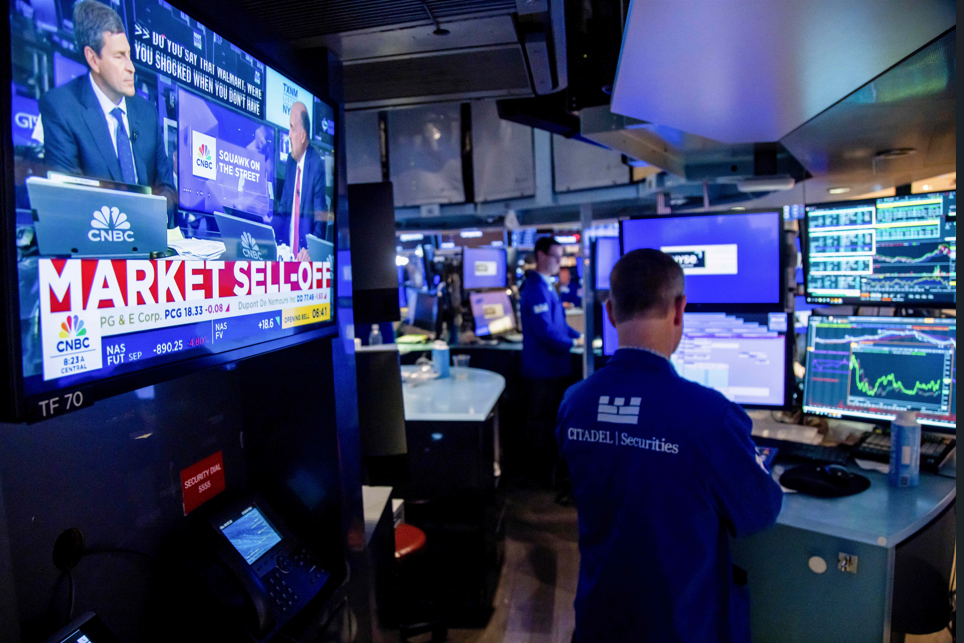
The stock selloff of the past month is forcing investors to think about whether the market remains too high, and if so, how far it might fall.
Has the US Federal Reserve gone too far in its fight against inflation, tipping the world’s largest economy into a damaging recession?
Hastily, investors have turned their worry about inflation into worry about a recession. The catalyst was Friday’s unexpectedly disappointing unemployment number.
Recent developments in the labor market triggered the Sahm Rule, an economic indicator known for predicting the onset of recessions. Developed by economist Claudia Sahm, it signals a recession when the 3-month average of the unemployment rate rises by at least 0.5 percentage points above its low from the previous 12 months.
Portfolio Managers Shuntaro Takeuchi, Michael Oh, CFA, and Andrew Mattock, CFA, assess the reasons for the heightened volatility and sharp moves in global markets.
The US Federal Reserve appears to have finally brought about the recession that it engineers whenever unemployment is low and the president is a Democrat. If it costs the party the White House in November, may its leaders use their time out of power to reflect on the unwisdom of their decades-old bargain with Wall Street.
Copper prices have pulled back since peaking in May at $5.12, but the long-term bull case for copper remains strong.
Until recently, the prevailing market narrative since October was that the Fed was in a "pivot" to eventual rate cuts.
As the late George HW Bush once said, “What is it about August?”
For bond investors looking to the near- and longer-term, Matt Eagan stepped through considerations and opportunities in the global market.
Friday’s jobs report has put a damper on economic sentiment for the moment. But much hype has been made about the so-called “Great Rotation.”
VettaFi Voices weigh in on key industry trends in 2024.
Join the experts at Amplify ETFs and learn how GLP-1's could revolutionize the weight loss drug market as well as a strategy that can give your portfolio exposure to a theme that could see significant growth in the coming years.
The ability of AI to demonstrate empathy holds great promise for enhancing user interactions and support services. However, its current limitations highlight the irreplaceable value of human empathy.
Savvy advisors that blend classic prospecting methods with modern tech are not only reviving successful strategies from the past but are also setting the stage for sustainable future growth.
To remain competitive and become a national brand, RIAs will almost certainly need the support of a capital partner. However, it’s important to critically evaluate those partners and ensure they are best equipped to offer support for a given RIA’s specific set of needs.
When I run sessions on dealing with difficult people one of the things I consistently point out is the gift that difficult people give us: they are known and their behavior is repeatable and can be anticipated.
Investor complacency is often blamed when rising stock markets ignore potentially unsettling data for weeks and then viciously sell off. But this very human-sounding characteristic mostly isn’t in the minds of traders: It’s baked into the structure of modern investment strategies.
Corporate borrowers are selling investment-grade bonds at the fastest clip since 2020 as companies take advantage of lower yields to issue debt before the November election.
Family Feud, a popular game show when I was growing up, would ask contestants to guess how a group of people had answered a specific question. It served as a regular and early reminder for me of the importance of supplementing one’s thinking with external perspectives.
Andy Rothman provides four reasons why he’s stubbornly convinced that Xi Jinping will eventually overcome his stubbornness and make the changes necessary to put China back on track to reach its potential growth rate.
Pullbacks are normal, but every time is scary. And every time we need to pay attention. But in the end, although there are real risks out there, right now everything is still fairly normal, in our view. We will be keeping an eye on things, but the best course of action remains simply this: keep calm and carry on.
One of the very popular technology companies in recent years has been CrowdStrike, Inc. It provides cybersecurity to numerous major technology companies including the top Artificial Intelligence (AI) players.
Turmoil in the markets has renewed fears that the US did not escape history after all, that a hard landing — a recession — is coming. Whether this is all a blip from a rising yen or a justified reaction to an actual weakening of the US economy is still unknowable.
Economist Claudia Sahm developed the “Sahm Rule,” which states that the economy is in recession when the unemployment rate’s three-month average is a half percentage point above its 12-month low.
Fiscal conservatism has more or less vanished from America’s political landscape. Government borrowing, despite the strong economy, continues to push public debt to record levels – and the presidential contenders and their parties say scarcely a word about it.
For months investors have faced a dilemma — pay through the nose for technology giants trading at eye-watering multiples, or wait for a cheaper entry point and risk missing out on the year’s biggest bull run.
North American trade is booming, but gains have been uneven.
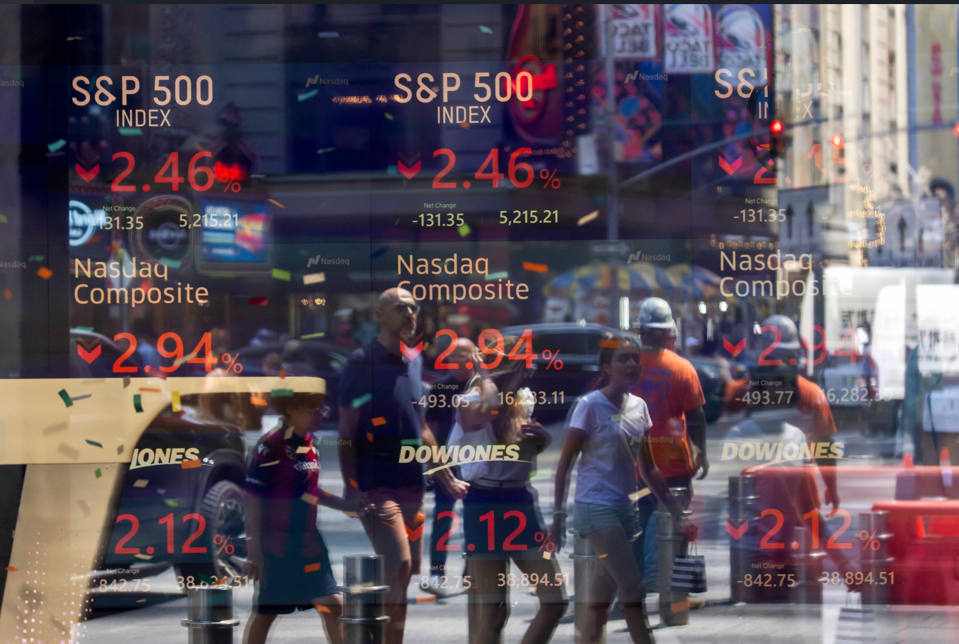
A negative market reaction was triggered by a sharp selloff in Japanese stocks into the close earlier [Monday], with the Topix and Nikkei indices suffering 12% declines – their worst day since 1987. The selloff cascaded through global markets with the EuroStoxx 600 trading down over 3% on Monday and S&P 500 down about 3%.
The Federal Reserve is being challenged with one of our most important tenets: levels versus momentum.
Take the market narrative with a grain of salt and look at the fundamentals in determining your outlook for the economy and financial markets. We ultimately believe this soft patch of data will prove to a be a ‘growth scare,’ not a ‘recession reality.’
Rotation - The Earth's axis has an inclination of 23.5 degrees relative to its orbital plane around the sun.
Buoyed by the Magnificent Seven, the first half of the year saw strong results for investors. But there are headwinds on the horizon — Fed policy changes, geopolitical tensions, and other factors that could impact market results.
Join the experts at State Street Global Advisors, Astoria Portfolio Advisors, and Clark Capital Management Group as they explore three takeaways from State Street Global Advisor's Midyear ETF Market Outlook: diversifying away from the Magnificent Seven, optimizing income through short-term core and credit, and positioning for macro volatility through real assets.
State Street’s George Milling-Stanley goes in-depth on the current gold market, physical gold ETFs, and crypto. VettaFi’s Roxanna Islam explores the world of defined outcome ETFs.
While strategy provides direction, a strong culture is the foundation that supports and sustains an organization’s success. Culture influences every aspect of an organization and defines the purpose and values that guide the actions of employees.
If there’s one thing that’s hard for many advisors to let go of, it’s the idea that a multi-step sales process is required to make the sale.
Join us for an insightful webinar where we delve into the transformative impact of Artificial Intelligence (AI) on society and explore innovative investment strategies that leverage this groundbreaking technology.
Buying US stocks after a slump of the scale witnessed over the past month has usually been profitable, according to a Goldman Sachs Group Inc. analysis of four decades of data.
A major rally in the $27 trillion Treasury market is laying bare anxiety that the US economy is sliding into recession and the Federal Reserve will need to start aggressively cutting interest rates.
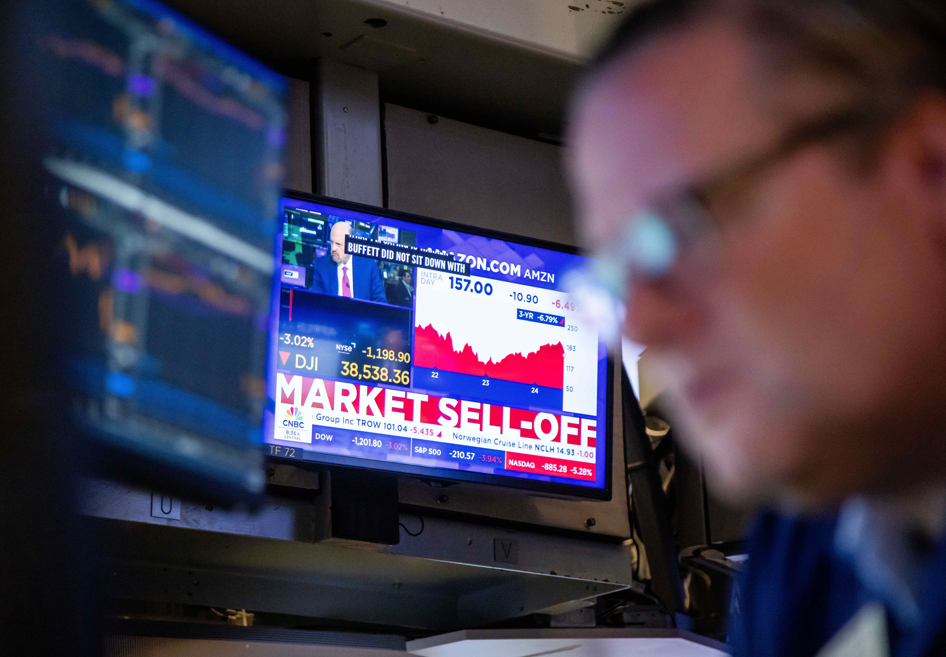
On days like Monday’s dramatic selloff, which capped a three-week loss of $6.4 trillion in global wealth, personal finance experts usually have the same advice for wary retail investors:
For a technology that promises to help businesses cut costs, artificial intelligence has had a big problem with being so costly.
Friday’s weaker-than-expected jobs report has sparked a robust debate about whether the economy is sliding into recession or whether the rise in the unemployment rate in July was due to a continuing post-pandemic normalization of the labor market.
The softening trends in both inflation and labor data are sending a message that monetary policy is too restrictive.